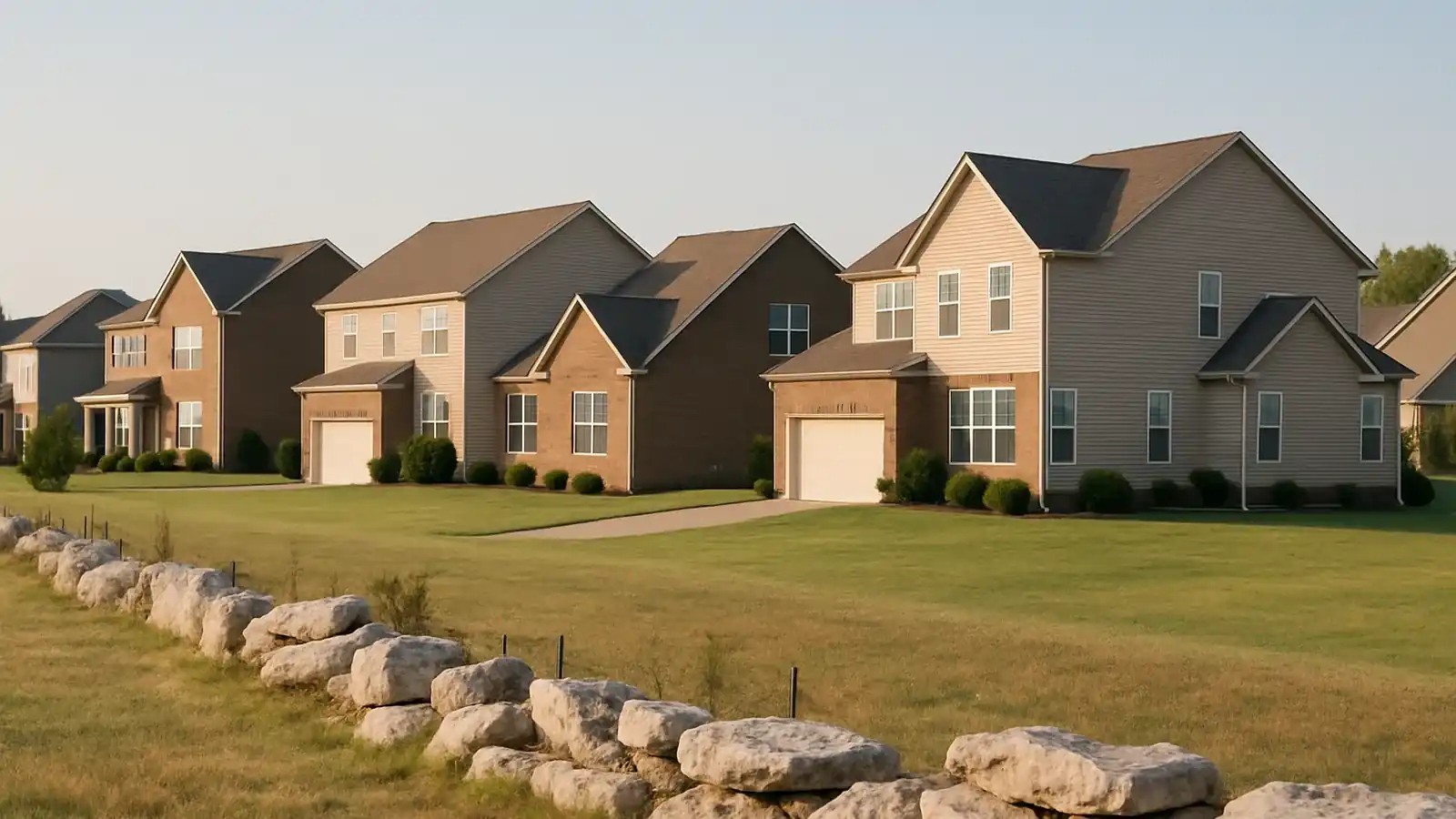
Rockvale homeowners pay $4,000–$15,000 for most structural foundation repairs, from about $400 for a single crack injection. Residual clay cycling over an uneven rock surface produces uneven bearing: exactly what a measured evaluation is built to find.
Farmland becoming subdivisions
Rockvale's recent growth converted agricultural land into residential development, and that transition carries a specific foundation implication. Farmland is graded for drainage and cultivation, not for building pads, so converting it involves substantial earthwork, and new homes frequently sit on placed fill of varying depth over the native Central Basin profile.
The practical consequence is the same fill-versus-clay question that runs through the county's growth areas, with one addition: former agricultural land sometimes carries legacy drainage infrastructure (old field tiles, filled ditches, farm ponds) that development didn't fully remove. Those features can concentrate subsurface water in places no one expects, and they show up in evaluations as moisture patterns that don't match the visible grading.
Building new? The cheapest foundation work is preventive
For homeowners in newly built Rockvale neighborhoods, the highest-value action is inexpensive: get the downspout extensions right, confirm the grading actually falls away from the house, and keep beds from trapping moisture at the wall. On clay, steady moisture is the whole game, and establishing good habits in year one costs a few hundred dollars against what correction costs at year twelve.
Asked in Rockvale
Our neighborhood was farmland five years ago. Does that matter?
It does. Converting agricultural land to building pads involves substantial earthwork, so most homes here sit on placed fill of varying depth. Old field tiles, filled ditches, and former ponds sometimes survive underground too, concentrating water in places the visible grading doesn't explain, so a good evaluation looks for those.
My house is brand new. What should I be doing now?
Cheap preventive work with outsized returns: get downspout extensions carrying water six feet or more from the wall, confirm the grading actually falls away from the house, and keep mulch beds from trapping moisture against the foundation. On clay, steady moisture is the whole game.
Is a builder-graded lot a problem?
Not inherently: proper grading and compaction are standard practice. The issue is simply that fill and native clay settle on different schedules regardless of how well the fill was placed. That's soil mechanics, not workmanship, and it's why newer neighborhoods here see movement around the ten-year mark.
Should I get an evaluation before anything cracks?
If you want a baseline, yes: a laser survey documents your floor elevations now, which makes any future change measurable rather than debatable. Many local specialists don't charge for it, and for new construction it frequently produces nothing but reassurance. An honest evaluation won't invent a problem to justify the visit.
Next step for your Rockvale house
Mark and date the crack, then get the baseline: knowing is cheap. The evaluation takes about an hour; ask for a written report with floor elevations. Costs are itemized in the cost guide; nearby communities are under service areas.
Get a Murfreesboro foundation evaluation
Tell us what the house is doing (stair-step cracks, doors that stick every August, sloping floors, separating trim) and we’ll pass your request on for an evaluation. A specialist who serves the Murfreesboro area will call you back.